It was a wonderful surprise to read in this week's Catholic Herald the report that a Mass has been said in the Old Rite in a little chapel attached to the Houses of Parliament! It doesn't seem to be reported widely upon, but
Joanna Bogle has written an account on her blog.
It was nice to have some positive spin on the Old Rite in this week's Catholic Herald, which over the past couple of weeks has included several negative remarks. This is, of course, due to the widespread reports of a
motu proprio being drafted by the Pope to allow more widespread use of this venerable Rite. The Catholic Herald itself reported on this, October 20th. In the same issue it reprinted an article written by James MacMillan entitled "
Bad Music is Destroying the Church." I actually felt compelled to write into the Herald (which I didn't in the end!) being so confused by the stance he takes in his report. On the one hand he laments at the awful 'reform' of the liturgy which took place after Vatican II, primarily due to the banal music which became commonplace:
Cultural vandalism... a destructive iconoclasm which wilfully brought to an end any remnant of its massive choral tradition and its skilful application to liturgical use.
What is odd is the way he then tries to avoid being branded "elitists, reactionaries and Tridentists" by making a sweeping statement which I didn't expect to find from such a reasoned account of recent liturgical history:
Reform [in the 1960s] certainly seems to have been overdue. The pre-conciliar liturgy by all accounts seems to have been a ritualised expression of the moribundity that had so calcified the Church.

What seems odd to me, about this and other "neo-trads" (which term I will subsequently use to describe such an attitude) is that they pigeonhole the music of the Tridentine liturgy as perfect while dismissing so much else. Are these choral masterpieces of Palestrina, Mozart &c really so easily transferred into the new Rite of Mass? Is it conducive to the
actuosa participatio which has driven so many of the liturgical reforms? Why do neo-trads fail to make any sort of connection between the form of the mass and the actual Rite itself? I have been to many Solemn High Masses at the Oratory, and seen the extent to which the New Rite of Mass can be 'dressed up' to make it appear closer to the ancient immemorial Tridentine Rite. The proponents of such a style of worship are to be commended on the one hand; that they are trying to level the liturgical innovations by setting them in their traditional context (and making the best of an undesirable situation).
However, on the other hand aren't they just dressing up an ugly Rite to make it look pretty? Being a member of the congregation at such a 'Solemn High Mass' makes one feel slightly like the spectator at a concert. It is inevitable, in that the New Rite forbids any liturgical activity to be happening at the altar whilst the choir/congregation are singing the responses. This leaves the Mass in an embarressing position: In order to incorporate such magnificent, long scores into the liturgy, the whole Sacrifice at the altar is postponed for several minutes. Much of the time the Priest and Servers are made to look, quite frankly,
bored - while they sit or stand waiting for the choir's moment of glory to pass.
I may never have noticed this if it weren't for experiencing a Sung Mass in the Old Rite, where the choir acts more as a background to the unfolding drama on the altar, rather than an end unto itself. These original liturgical masterpieces were designed to often accompany the action of the priest; hence their longevity. I don't expect everyone to agree with these points, and there are many other comparisons to make between high masses in either Rite, which I will likely make over the course of this blog.
But back to the story of the
Catholic Herald! A week after this brief coverage of the rumoured 'universal indult' the paper was ablaze with snide remarks about the Old Mass. First up, and most relevant, is by a regular columnist: Gerard Noel promises "
enough has been said on this topic for nothing more to be remarked here" .....
EXCEPT..... He goes on to make this lengthy point:
The Tridentine Mass is sometimes thought to have age and venerable tradition on its side - as opposed to the form of Mass authorised by Pope Paul VI in 1969. The latter, by contrast, is sometimes supposed to have introduced all sorts of novelties and new ideas. The opposite, in fact, is true. The Tridentine Mass dates from the medieval period when it began to incorporate many novelties unknown to an earlier period - a perfectly acceptable case, of course, of doctrinal development. The modern Mass, on the other hand, is substantially based on the Eucharist of the first Christian centuries.

My goodness. Does anyone expect me to believe the Pauline Missal was discovered during an excavation of a pre-medieval monestary or something? That 'Eucharistic Prayer number 3'
wasn't written by an 'expert liturgical commission'? That novelties such as clown masses and consecrated Corn chips is on the same scale as reciting psalm 42 at the foot of the altar? I'm lost for words.
But I have only just started, since the Herald also reported on the
uproar by French Bishops, which seems to confuse the whole issue about the liberalising of the Old Mass with the reunion of the SSPX (I would assert that although the two are related they are by no means connected). The article closes with the words of the protesting French priests: "
work in the world as it is rather than plunge us back into the liturgical life of another age." Now, I could be wrong, but wasn't the reforms mandated by Vatican II an attempt at 'plunging us back' into the liturgical life of the early Church? Gathering around a table to celebrate the Eucharist? Come on, make up your mind guys!
I expected there to be something about the Old Mass in the letters page; Mr. Chris Feetenby from N. Yorks obliged by pointing out the Old Rite is deficient because it doesn't allow the following provisions (
wait for it!):
To which I think I would reply: "Good; Good; Good; Good; Good; and don't be silly!!"
An interview with Cardinal Cormac Murphy O'Connor even touches on the rumour of a universal indult. To which His Eminence answers,
Liturgical renewal won't change? But isn't it always changing? In many parishes I've been to, the Mass seems to change week-on-week. But seriously, I hope the Pauline Missal won't retain the same power and authority the Tridentine Missal did: I cannot bear the idea of my distant descendants joining the Church in saying "through your goodness we have this bread to offer" for the next 400 years until another 'renewal' happens. By that time the 'People of God' will have lost all interest, and there will be nothing left to reform.
Well, all this came at a time when my subscription to the Herald was up for renewal.... (Hmmm.... there's that word again!) But regular traditionalist readers of this esteemed conservative newspaper will be happy to know that in this week's issue there is also a wonderful article reproduced from Eamon Duffy's address at CIEL UK 2006 entitled "Benedict XVI's mission to restore the glories of the Catholic liturgy." It is a wonderful read and really makes me want to purchase a copy of "The Spirit of the Liturgy" by our wonderful Holy Father, the then-Cardinal Ratzinger! We have a lot to look forward to in this papacy, and its going to be quite a ride!


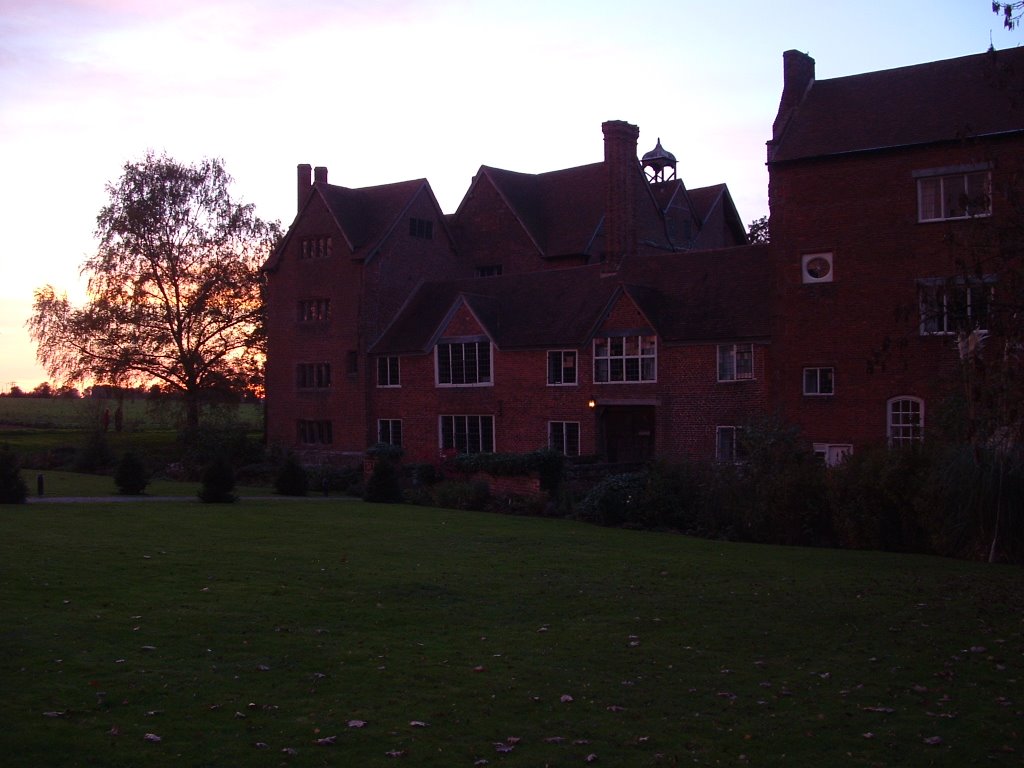
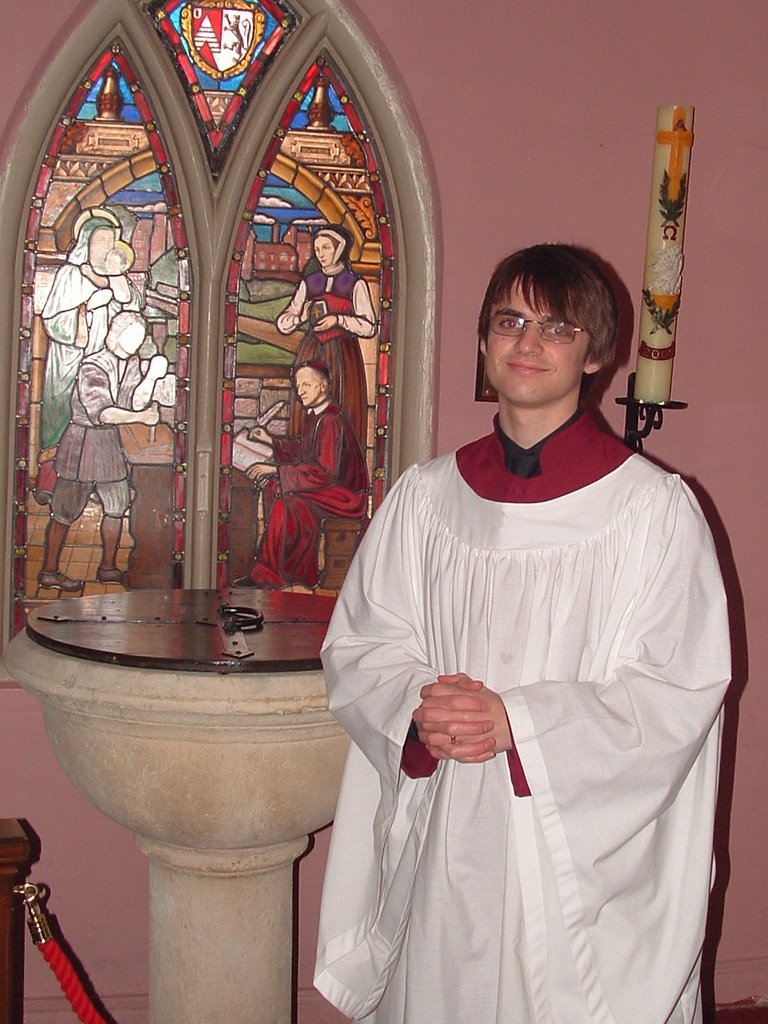 Now, those who avidly read the Mass of Ages will notice that I am the recent addition to their servers at this monthly mass, which I am very honoured to be able to now do. This time I was acolyte, and thank God, didn't mess up too much! Note in the above picture the figure of Cardinal Newman in the brand new stained glass window in the church's porch above the baptism font.
 You will notice me on the right, and Fr. Higham in his fine gothic black chausable. The sanctuary is quite crampted due to the alter being removed from the wall, but the wonderful tabernacle and stained-glass windows are, I believe, features of the original church. Fr. Higham has just published a book on the history of Harvington Hall, which I hope to soon purchase.


 Today is the important feast of All Souls, intimately linked to yesterday's All Saints. I have not been to mass to observe this feast, but said today's Vespers.
 God must be having a laugh. I was in the medical school today, quietly eating my lunch in an equally quiet common room. Gradually it began to fill up with medical students (little whipper-snappers compared to my veteran 6 years at the place) and I even got chatting with a Catholic girl from the chaplaincy.
 I ended up staying; first to finish my lunch, then to get the dusty bible out of my bag and go through some verses on "peace". I was disappointed to see they didn't include my personal favourite saying of Jesus on peace, from St. Matthew's Gospel, Chapter 10 verses 34-35:
  I am always impressed with the way this edition of the bible succinctly sets verses in context, especially Old Testament ones. Our discussion was interesting, but on reflection I realised that I was picking my words and being careful not to give the game away that I was Catholic! This is a terrible thing, and I fear it's what often happens with ecumenism. To 'get along', we Catholics are pressured to take our religion down to the lowest common denominator and forget those beautiful things which make our faith so rich and vibrant.