Showing posts with label Harvington Hall. Show all posts

Wednesday, February 18, 2009

Requiem for Fr David Higham

Oulton Abbey, Stone
Wednesday, March 11th 2009
7pm
(Sung Mass in Traditional Rite)

Father David Higham died at Oulton Abbey on Saturday 22nd November 2008. When I wrote a eulogy about him, I was overwhelmed by the response from people who knew Fr Higham, especially his old novices from Farnborough.

I only knew Fr Higham in his last couple of years in the context of his support for the Latin Mass Society in Worcestershire (my wife's birthplace), but I daresay that Oulton Abbey had great significance in his life. It was to this community that Fr Higham 'fled' both in the early 90s upon leaving Farnborough, and in 2008 upon being struck down by a Stroke. He must have cared compassionately for the sisters there as chaplain, and it was there he was compassionately cared for in his final days.

He was a testament to the fatherly love a Priest should have for his flock, and his consideration in providing the traditional Rites of the Church for his faithful was truly moving. When asked, he even gave Wendy her 'Churching' upon returning to Mass for the first time after giving birth, despite never having performed such a ceremony, understandably, in his many pre-conciliar years as Monk-priest!

We were very sorry to have been prevented from attending Fr Higham's funeral due to freak traffic conditions (although over 150 managed to attend), and hope to be able to pay our respects in this simple way.

Above: Fr Higham saying a Requiem Mass on Sunday, November 5th 2006

Sunday, November 23, 2008

R.I.P. Fr Higham

It is with sadness that I learn of the death of Fr David Anthony Higham this weekend. I have known him since attending his parish of St Mary's at Harvington Hall in Worcestershire, where he said a traditional Latin Mass every month. Earlier this year he suffered a stroke and has since been recovering at Oulton Abbey in retirement.

Fr Higham was parish priest at Harvington Hall from 1999 till 2008. He wrote the book "The Priests and People of Harvington" published in 2006, which has been an excellent contribution to the history of this important recusant area. I have written a little about Harvington Hall before, but want to reflect today on his life, mainly in his own words, and recount some of the contributions Fr Higham made to the parish.

David Higham was educated by the Dominicans at Blackfriars, Laxton, and entered the Benedictine Order at Prinknash Abbey, Gloucestershire in 1944. He was subsequently sent with other monks to repopulate St Michael's Abbey at Farnborough in Hampshire. He was ordained priest in 1954, and eventually appointed superior at Farnborough. In 1980, when the monastery achieved autonomy, he was elected conventual prior. For three years Dom Higham also combined his duties with that of parish priest of Our Lady of Lourdes in nearby Cove.

Ten years later, for reasons Fr Higham was always quite reserved about, he relinquished his office of prior and returned to the Midlands to become chaplain to the Benedictine nuns at Oulton near Stone in Staffordshire (It was here that Fr Higham returned to be nursed in his final months). Around this time he was briefly the superior of a small traditional monastic community at Alton, which included fellow monk Dom Andrew Southwell.

Fr Higham joined the Archdiocese of Birmingham in 1997, and after serving parishes in Staffordshire was assigned to the metropolitan Cathedral of St Chad's in the city centre of Birmingham. It was therefore with pleasure that Fr Higham was then reassigned in 1999 to his beloved countryside of Worcestershire and the little parish of Harvington.

Fr Higham soon set about restoring the Georgian-style priest's house adjoining the church of St Mary's, and investigating the archives. For company he shared the house with a border collie and two Burmese cats, who Fr Higham commented managed to live together more peacefully than some humans he has known! It was with sadness that his dog died in 2007, and Fr Higham hoped to be soon buried in the same grave in the garden of the Priest's House.

Fr Higham will leave a grand legacy behind him at the parish of Harvington, the shrine of St John Wall: in 2003 the roof and walls were repaired and refurbished to include angelic paintings on each ceiling overlooking the sanctuary (see pictures below). Other refurbishments include improved fittings for the reredos and tabernacle, a brass eagle lectern (where I will always remember Fr Higham's beautiful, intelligent and powerful sermons), new stained glass windows, new oak seating, and new paving outside the porch. Of note is also a sculpture of St John Wall by Gabrielle Mercer.

Fr Higham celebrated his Golden Jubilee of Priestly Ordination in 2004. I hope that we may pray fervently and confidently upon his death, and dedicate his life's work back to God, whom he laboured so tirelessly for.

Subveníte Sancti Dei, occúrrite Angeli Dómine, Suscipiéntes ánimam ejus, Offeréntes eam in conspéctu Altísimi.

Suscípiat te Christus, qui vocávit te, et in sinum Abrahæ Angeli dedúcant te. Suscipiéntes ánimam ejus, Offeréntes eam in conspéctu Altíssimi.

Come to his assistance, all ye Saints of God: meet him, all ye Angels of God: receiving his soul, offering it in the sight of the Most high.
May Christ receive thee, who hath called thee, and may the Angels conduct thee to Abraham’s bosom. Receiving his soul and offering it in the sight of the Most High.

Sunday, February 03, 2008

Royal Regalia

Last Pentecost, we were fortunate enough to be present for a magnificent sung Mass at Harvington Hall. I was also fortunate enough to have my camera with me, and was quickly prompted to get lots of photos of an unusual and historic priestly vestment which was generously donated for use at this Mass. It is the 'Catherine of Aragon' Chasuble!

Since that day, I have been eager to find out more about the history of the Chasuble, which you can see Fr David Higham wearing. Now, in the latest edition of Mass of Ages, David Hurd writes all about it (published with a B&W copy of my above photo):

This vestment was bequeathed to the Catholic Church in Ludlow in 1958 by Sir Walter Blount of Mawley Hall in Shropshire.
The Blount family believed it to have been a gift from Catherine of Aragon to Elizabeth Blount, her Lady-in-Waiting.
Recent research suggests more accurately that it was pieced together after Catherine's death in January 1536. In her will she asks that "Her gowns (of velvet and cloth of gold) held by King Henry VIII be made into Church Vestments."
Repair and restoration work was carried out by Mrs Monica Meek of St Peter's Parish in Ludlow. She died in 2006 aged 96 and the chasuble was worn by the celebrant at her Requiem Mass.
Catherine's biographer, F. Claremont (1939), states that "among Catherine's embroidery her emblem, the pomegranate, features prominently." The cloth of gold used for the cross piece on the vestment was made in Florence in the period 1470-1500 and imported into Spain; it then came with Catherine to England and to Ludlow in 1501. The cross piece is made up from cuttings of the original garment to prominently feature the pomegranates.
Catherine's will requested that the furs from her garments be given to her daughter Mary who probably had the vestment made and to which she added her mother's embroidery work.
The story of Henry's wives and his defiance of the Catholic Church is famous enough to avoid repetition here. In brief commentary, therefore, I would say that this historical vestment should remind us of a calamitous time in English history, but also of the love and devotion which was passed on and reserved for the true Faith. With the protestant reformation, much was lost; things like this chasuble were literally torn to pieces.

The shreds of devotion which remained in our country began with Catherine, and perhaps testify to her noble and tragic place in all this. Before dying, she wrote a final plea to the schismatic king, now already remarried and treating her with ignominy:

My most dear lord, King and husband,

The hour of my death now drawing on, the tender love I owe you forceth me, my case being such, to commend myself to you, and to put you in remembrance with a few words of the health and safeguard of your soul which you ought to prefer before all worldly matters, and before the care and pampering of your body, for the which you have cast me into many calamities and yourself into many troubles. For my part, I pardon you everything, and I wish to devoutly pray God that He will pardon you also. For the rest, I commend unto you our daughter Mary, beseeching you to be a good father unto her, as I have heretofore desired. I entreat you also, on behalf of my maids, to give them marriage portions, which is not much, they being but three. For all my other servants I solicit the wages due them, and a year more, lest they be unprovided for. Lastly, I make this vow, that mine eyes desire you above all things.

Katharine the Queen.

Please keep Fr Higham in your prayers, after having suffered a stroke last week. May he make a steady and full recovery.

Sunday, May 27, 2007

Veni, Sancte Spiritus

The title Veni, Sancte Spiritus is the golden sequence sung at Mass today, at Harvington Hall's parish of St. Mary's. It is a beautiful hymn, probably written by Cardinal Stephen Langton, Archbishop of Canterbury in the 13th Century. He was a great legislator, and Fr Higham reminded us in his homily that he was appropriately also a great poet. What a combination so treasured in our Church!

There was something else very special for today's celebration of Pentecost. Not only did we have the Neri Singers lifting our hearts and minds; the delicate precision and noble elegance of the Tridentine Mass; the sweet smell of incense; and the incredible mystery of Our Lord truly present under the appearance of humble bread and wine... but there was a very special chasuble being worn by Fr David Higham! I haven't all the details to hand, but this exquisite vestment dates back to the 15th Century, and features an elegant red cross made using the fabric from one of Catherine of Aragon's dresses, explicit in her last will and testament. What thoughts and feelings this evokes. I will provide more photos and details about this in due course.

Fr Higham preached an inspiring sermon as always. What more appropriate occasion to reflect upon this day, than the unfortunate situation in Brazil where the Holy Father has recently visited? They have the largest Catholic population, but huge numbers are being plucked away by 'Pentecostal' sects. What do these sects claim to have over and above the Church? Rather than set, rubrical forms of worship led by a priest; they have spontaneous, lively preaching and music. Rather than intricate and complicated doctrines; they boast basic and simple biblical truths. "The gifts of the Holy Spirit living and active in believers today." Can the Catholic Faith boast these things?

The Catholic Church holds the day of Pentecost in high esteem, commemorating it on this day. It was this event which founded the Church with the living, Holy Spirit of God. It is this Spirit which is active in the Church throughout the centuries; to preserve her, teach and instruct her, and inspire her members towards holiness and sanctification. This is far more beautiful and divine than warm subjective feelings and outbursts of joy. Such feelings can be reproduced in the most secular of settings, and lend more to a kind of social interaction rather than a living and present divine reality. The Catholic Faith provides sustenance and sanctification through the Holy Spirit's special action in the Sacraments. In particular, at the Mass it is the power of the Holy Spirit which transforms our reality into the heavenly realm: by re-presenting the sacrifice on Calvary of our Lord Jesus Christ; by transforming our earthly gifts of bread and wine into His Body and Blood, the Lamb of God, the Bread from Heaven in which we partake in the eternal banquet. That is a reality which Our Lord begged us to accept like little children, or our Life in the Spirit is simply not possible, and we cannot enter God's Kingdom.

Ecce Agnus Dei, ecce qui tollit peccata mundi
"If any one love Me, he will keep my word, and My Father will love him, and We will come to him and will make Our abode in him."
St John 14:23

Let us echo the words: "Veni, Sancte Spiritus" and like St Philip Neri, experience that great inrush of the divine Spirit into our hearts. One which for Philip, resulted in an overwhelming burning and divine delight, the likes of which overflowed into the hearts of everyone he met, drawing them into the Church and saving their souls. If we reduce the action of the Holy Spirit into a simple transient community experience then we reduce the Church to an earthly and individualistic realm. Through obedience and authority we accept a higher divine guidance of Christ's body, the Church, one which Our Lord promised the apostles would "teach you all things, and bring all things to your mind, whatsoever I shall have said to you."

Thursday, March 01, 2007

Missa Cantata for Passion Sunday

Harvington Hall Missa Cantata
Sung Latin Mass at St. Mary's Church, Harvington Hall
(Shrine of St. John Wall and the English Martyrs)

25th March 2007 at 3pm

The Traditional Feast Day of

Passion Sunday

Hear the timeless words:
"Judica me, Deus, et discérne causam meam de gente non sancta"
(Judge me, O God, and distinguish my cause against an ungodly nation)
sung by the wonderful Neri Singers

Celebrant: Fr. David Higham
Choir: The Neri Singers
Courtesy of The Latin Mass Society

Monday, February 05, 2007

Wendy's Churching

On Sunday we attended the Harvington Hall Mass, which we generally go to once a month. On this occasion I could write about the feast of Septuagesima (which precedes Lent in the old calender) or the blessing of throats through the intercession of St. Blase (which was kindly bestowed by Fr. Higham at the end of Mass). But on this occasion it is only right that I address the most joyful event for us personally: Wendy's Churching.

Most people would not have heard of this old custom. The Church permits women to stay at home, without culpability, for up to 6 weeks after childbirth (clearly Wendy has not taken advantage of this extended time, and is, as ever, desperate to go to Mass!). On the occasion of her first outing, a woman is formally 'Churched' by a priest. This is traditionally after 40 days to mirror the Purification of the Blessed Virgin Mary, which occured 40 days after the birth of Jesus. However, under the New Covenant a purification is no longer required (indeed Mary's was only ceremonial and an act of obedience to the Old Covenant). The Churching of Women is, therefore, an act of thanksgiving to the Lord for a safe birth and the gift of a new child.

The ceremony involved the greeting of Wendy, holding a lighted candle, by the priest in the narthax of the church. Psalm 23 was then recited by the priest, with the antiphon; "She shall receive a blessing from the Lord, and mercy from God her Savior: for this is the generation of them that seek the Lord":

The Earth is the Lord's and the fullness thereof; the world, and all they that dwell therein.

Dómini est terra et plenitúdo ejus: orbis terrárum, et univérsi qui hábitant in eo.

For He hath founded it upon the seas; and hath prepared it upon the rivers.

Quia ipse super mária fundávit eum: et super flúmina præparávit eum.

Who shall ascend into the mountain of the Lord: or who shall stand in His holy place?

Qui ascéndet in montem Dómini? aut quis stabit in loco sancto ejus?

The innocent in hands and clean of heart, who hath not taken his soul in vain, nor sworn deceitfully to his neighbor.

Innocens mánibus et mundo corde: qui non accépit in vano ánimam suam, nec jurávit in dolo próximo suo.

He shall receive a blessing from the Lord, and mercy from God his Savior.

Hic accípiet benedictiónem a Dómino: et misericórdiam a Deo salutári suo.

This is the generation of them that seek Him, of them that seek the face of the God of Jacob.

Hæc est generátio quæréntium eum, quæréntium fáciem Dei Jacob.

Lift up your gates, O ye princes, and be ye lifted up, O eternal gates: and the King of glory shall enter in.

Attóllite portas, príncipes, vestras, et elevámini, portæ æternáles: et introíbit Rex glóriæ.

Who is this King of glory? the Lord Who is strong and mighty: the Lord mighty in battle.

Quis est iste Rex glóriæ? Dóminus fortis et potens. Dóminus potens in prælio.

Lift up your gates, O ye princes, and be ye lifted up, O eternal gates: and the King of glory shall enter in.

Attóllite portas, príncipes, vestras, et elevámini, portæ æternáles: et introíbit Rex glóriæ.

Who is this King of glory? the Lord of hosts, He is the King of glory.

Quis est iste Rex glóriæ? Dóminus virtútum ipse est Rex gloriæ.

Then Wendy took the priest's stole and was led down to the sanctuary:
Enter into the temple of God, adore the Son of the blessed Virgin Mary, who gave you fruitfullness of offspring.
There she knelt, whilst the priest prayed (in Latin, of course!):
Almighty, everlasting God, through the delivery of the blessed Virgin Mary, Thou hast turned into joy the pains of the faithful in childbirth; look mercifully upon this Thy handmaid, coming in gladness to Thy temple to offer up her thanks: and grant that after this life, by the merits and intercession of the same blessed Mary, she may merit to arrive, together with her offspring, at the joys of everlasting happiness. Through Christ our Lord.
She was then blessed with a sprinkling of holy water and wished all the grace and blessing necessary for the raising up of our new child. I accompanied them throughout the ceremony holding little Maddy (who was also subject to some holy water sprinkling)!

What a wonderful time to celebrate this event in our lives: just after we commemorated the Purification of the Blessed Virgin Mary (Candlemas on Friday), which is the symbolism behind Wendy holding the candle. Also what a wonderful place to have such a ceremony: the shrine of St. John Wall and the English Martyrs, at a site of preservation of Catholic Heritage during a period of persecution. How wonderful to be able to celebrate the Mass which those Martyrs fought and died for; to be able to unite our prayer with theirs, and seek their constant support and consolation.

Next is Madeleine's Baptism on Saturday. We hope that it will be a blessed day, and that Maddy has the patience to endure all the attention from the 30+ guests who are coming for the special occasion!

My thanks to Fisheaters for an excellent reference as always.

Saturday, December 23, 2006

History of Harvington

At last I have bought it. This post comes a bit late for Christmas presents, but nevertheless:

David Anthony Higham. The Priests and People of Harvington: 1580-2006. Gracewing Publishing: Hertfordshire, 2006

I really recommend this book by the wonderful parish priest of Harvington Hall, Fr. David Higham, who has been a priest of the archdiocese since 1997, before which he was educated by the Dominicans at Blackfriars, Laxton, and served the Benedictine order for many years. His special interest is history and architecture, particularly post-reformation English Catholicism. Here follows the synopsis of his book:

Few present-day Catholic communities in England can claim a continuous history going back to the sixteenth century, to the days of the restoration of the Church under Mary Tudor and the persecutions of Elizabeth I. Harvington, a small parish in the Archdiocese of Birmingham, is one.

Its moated manor house in the north Worcestershire countryside became an important centre for the undercover mission maintained throughout the Penal Days by the recusant Pakington and Throckmorton families and their priests, who could be sheltered in the many hiding places for which the Hall is celebrated.


The story of the Harvington mission is, in fact, a study in continuity in which not only the Catholic aristocracy and their chaplains, but also the yeomen and labourers have their place. The growth of the Catholic population in neighbouring towns brought about the closure of most country-house mission, yet Harvington has survived into modern times despite the departure of the lords of the manor and the break up of their estate.


Its survival is entirely due to the untiring efforts of a wealthy benefactress, Ellen Grant-Ferris of King's Norton, in saving the Hall, a building of great architectural and historical significance, from demolition. Now a shrine to St. John Wall and his fellow martyr priests of the Midlands, the Hall, along with the neighbouring Church and Priest's House, is in the care of the Archdiocese of Birmingham.


This book tells the fascinating and often heroic story of the mission and the people of Harvington from 1580 to the present day. Chronicling one of England's most important Catholic sites, it contains a wealth of fascinating detail for local and family historians, as well as for anyone with an interest in Recusant History or in how the Church has been formed in England.
For more on my involvement with Harvington Hall see a previous post.

Ember Saturday

Having just attended an edifying low Mass at Harvington, I thought it would be wonderful to show the lessons of this important day. It is quite strange to have only 3 candles lit on our advent wreath when it's this close to the Nativity of Our Lord Jesus Christ (Christmas)!

The Mass today was in the special location of the Georgian chapel in the grounds of Harvington Hall. I will also take this opportunity to promote the parish priest David Higham's new book: The Priests and People of Harvington 1580-2006. From this book, displaying the chapel on the cover, I can tell you that this Georgian chapel was built at the house following the use of 'secret chapels' within the house itself during the reformation. In 1743 the garrets of two cottages were adapted and made into a little chapel, accessible via a staircase. It was only in 1791 that Catholics were given permission to worship in England, and so the chapel was still relatively secretive, being inside the moat and appearing secular on the outside. The original oak altar boasted several relics inside, which were unfortunately destroyed in a great fire of 1824.

It was then that St. Mary's church was built, which is the present parish church. However, the Georgian chapel was restored in 1986. It is now suitably adorned with a late eighteenth century altar and communion rails from St. Joseph's, Upton-upon-Severn, which is said to have belonged to a former Jesuit, John Joseph Reeve (1781-1848). Above the altar hangs a wonderful 17th Century painting of the Blessed Virgin and Child with St. Dominic and other saints after Barroccio. Mass is offered here every Saturday by Fr. Higham, and was a perfect setting for a Mass in the Classical Roman Rite.

Ember Saturday: All the elements of this Mass show every sign of being part of the ancient liturgy: the numerous lessons, interspersed with responsories and collects, recall the primitive form of the night vigil at Rome. On this night of ordinations twelve long lessons (as on Holy Saturday) were read to the people gathered in the Vatican basilica; the six lessons of today's Mass are a relic of this ancient practice. In reading this we are filled with a holy impatience at the approach of Christmas. We read the most beautiful prophecies of Isaiah, giving urgent appeal to the greatness of the Messiah and Saviour. The Epistle of St. Paul speaks of the second coming, but it is even now, as well as in eternity, that "the crooked shall be made straight, and the rough ways plain" (Gospel).
- Adapted from the Saint Andrew Daily Missal, 1954
- Following readings from Douay-Rheims Bible

First Lesson: Isaiah 19. 20-22
It shall be for a sign, and for a testimony to the Lord of hosts in the land of Egypt. For they shall cry to the Lord because of the oppressor, and he shall send them a Saviour and a defender to deliver them. And the Lord shall be known by Egypt, and the Egyptians shall know the Lord in that day, and shall worship him with sacrifices and offerings: and they shall make vows to the Lord, and perform them. And the Lord shall strike Egypt with a scourge, and shall heal it, and they shall return to the Lord, and he shall be pacified towards them, and heal them.

Second Lesson: Isaiah 35. 1-7
The land that was desolate and impassable shall be glad, and the wilderness shall rejoice, and shall flourish like the lily. It shall bud forth and blossom, and shall rejoice with joy and praise: the glory of Libanus is given to it: the beauty of Carmel, and Saron, they shall see the glory of the Lord, and the beauty of our God. Strengthen ye the feeble hands, and confirm the weak knees. Say to the fainthearted: Take courage, and fear not: behold your God will bring the revenge of recompense: God himself will come and will save you. Then shall the eyes of the blind be opened, and the ears of the deaf shall be unstopped. Then shall the lame man leap as a hart, and the tongue of the dumb shall be free: for waters are broken out in the desert, and streams in the wilderness. And that which was dry land, shall become a pool, and the thirsty land springs of water. In the dens where dragons dwell before, shall rise up the verdure of the reed and the bulrush.

Third Lesson: Isaiah 40. 9-11
Get thee up upon a high mountain, thou that bringest good tidings to Sion: lift up thy voice with strength, thou that bringest good tidings to Jerusalem: lift it up, fear not. Say to the cities of Juda: Behold your God: Behold the Lord God shall come with strength, and his arm shall rule: Behold his reward is with him and his work is before him. He shall feed his flock like a shepherd: he shall gather together the lambs with his arm, and shall take them up in his bosom, and he himself shall carry them that are with young.

Fourth Lesson: Isaiah 45. 1-8
Thus saith the Lord to my anointed Cyrus, whose right hand I have taken hold of, to subdue nations before his face, and to turn the backs of kings, and to open the doors before him, and the gates shall not be shut. I will go before thee, and will humble the great ones of the earth: I will break in pieces the gates of brass, and will burst the bars of iron. And I will give thee hidden treasures, and the concealed riches of secret places: that thou mayest know that I am the Lord who call thee by thy name, the God of Israel. For the sake of my servant Jacob, and Israel my elect, I have even called thee by thy name: I have made a likeness of thee, and thou hast not known me. I am the Lord, and there is none else: there is no God, besides me: I girded thee, and thou hast not known me: That they may know who are from the rising of the sun, and they who are from the west, that there is none besides me. I am the Lord, and there is none else: I form the light, and create darkness, I make peace, and create evil: I the Lord that do all these things. Drop down dew, ye heavens, from above, and let the clouds rain the just: let the earth be opened, and bud forth a saviour: and let justice spring up together: I the Lord have created him.

NB. "create evil" - The evils of afflictions and punishment, but not the evils of sin


Fifth Lesson: Daniel 3. 47-51 (& Hymn: Daniel 3. 52-56)
And the flame mounted up above the furnace nine and forty cubits: And it broke forth, and burnt such of the Chaldeans as it found near the furnace. But the angel of the Lord went down with Azarias and his companions into the furnace: and he drove the flame of the fire out of the furnace, And made the midst of the furnace like the blowing of a wind bringing dew, and the fire touched them not at all, nor troubled them, nor did them any harm.

Then these three as with one mouth praised, and glorified, and blessed God in the furnace, saying: Blessed art thou, O Lord the God of our fathers: and worthy to be praised, and glorified, and exalted above all for ever: and blessed is the holy name of thy glory: and worthy to be praised, and exalted above all in all ages. Blessed art thou in the holy temple of thy glory: and exceedingly to be praised, and exceeding glorious for ever. Blessed art thou on the throne of thy kingdom, and exceedingly to be praised, and exalted above all for ever. Blessed art thou, that beholdest the depths, and sittest upon the cherubims: and worthy to be praised and exalted above all for ever. Blessed art thou in the firmament of heaven: and worthy of praise, and glorious for ever.

Epistle: 2 Thessalonians 2. 1-8
And we beseech you, brethren, by the coming of our Lord Jesus Christ, and of our gathering together unto him: That you be not easily moved from your sense, nor be terrified, neither by spirit, nor by word, nor by epistle, as sent from us, as if the day of the Lord were at hand. Let no man deceive you by any means, for unless there come a revolt first, and the man of sin be revealed, the son of perdition, Who opposeth, and is lifted up above all that is called God, or that is worshipped, so that he sitteth in the temple of God, shewing himself as if he were God. Remember you not, that when I was yet with you, I told you these things? And now you know what withholdeth, that he may be revealed in his time. For the mystery of iniquity already worketh; only that he who now holdeth, do hold, until he be taken out of the way. And then that wicked one shall be revealed whom the Lord Jesus shall kill with the spirit of his mouth; and shall destroy with the brightness of his coming.

NB. "A revolt" - This revolt, or falling off, is generally understood, by the ancient fathers, of a revolt from the Roman empire, which was first to be destroyed, before the coming of Antichrist. It may, perhaps, be understood also of a revolt of many nations from the Catholic Church; which has, in part, happened already, by means of Mahomet, Luther, &c., and it may be supposed, will be more general in the days of the Antichrist.


"The man of sin" - Here must be meant some particular man, as is evident from the frequent repetition of the Greek article: 'the man of sin, 'the son of perdition, 'the adversary or opposer. It agrees to the wicked and great Antichrist, who will come before the end of the world.


"In the temple" - Either that of Jerusalem which some think he will rebuild; or in some Christian church, which he will pervert to his own worship: as Mahomet has done by the churches of the east.


Gospel: Luke 3. 1-6
Now in the fifteenth year of the reign of Tiberius Caesar, Pontius Pilate being governor of Judea, and Herod being tetrarch of Galilee, and Philip his brother tetrarch of Iturea, and the country of Trachonitis, and Lysanias tetrarch of Abilina; Under the high priests Annas and Caiphas; the word of the Lord was made unto John, the son of Zachary, in the desert. And he came into all the country about the Jordan, preaching the baptism of penance for the remission of sins; As it was written in the book of the sayings of Isaias the prophet: A voice of one crying in the wilderness: Prepare ye the way of the Lord, make straight his paths. Every valley shall be filled; and every mountain and hill shall be brought low; and the crooked shall be made straight; and the rough ways plain; And all flesh shall see the salvation of God.


O God, who sees that we are afflicted because of our wickedness,
grant in Thy mercy that we may be comforted by Thy visitation.
Who lives and reigns with God the Father in the unity of the Holy Spirit,
One God, world without end. Amen.

Wednesday, November 08, 2006

Stained Glass Window

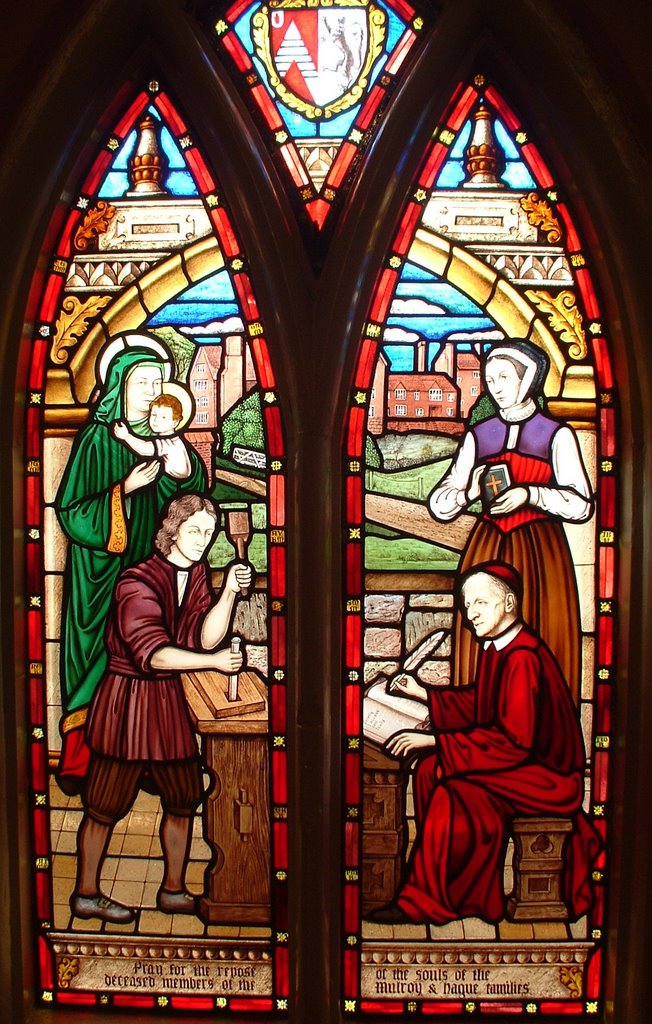
Further to my recent post of Harvington Hall, I thought I would put up this picture of the modern memorial stained glass window which is a beautiful feature in the porch.

Someone commented that they particularly liked it, and perhaps as a little game we could see if anyone can name who the figures are. I believe they're all of local significance! I didn't take note myself, but there is a plaque next to it making it very clear, and next month I will make sure I can provide the answers!

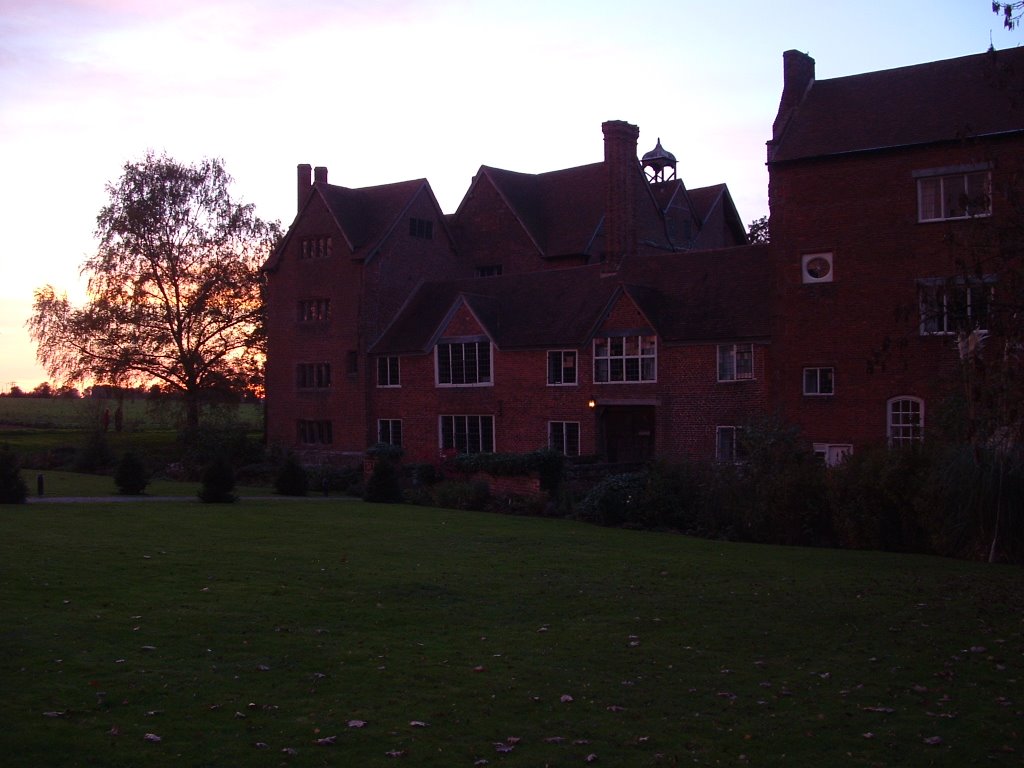
After that wonderful requiem mass on Sunday, it was also a particularly moving scene to have tremendous sunset throughout the drive back to Birmingham. I couldn't resist sharing the picture with you:

Please pray for me: I am struggling with work, in fact struggling even getting out of bed, after a week of insomnia and interrupted sleep. And with a baby soon to come?! How will I cope?! I am seeing the doctor today, so there will be the option of sedation at least...

Sunday, November 05, 2006

Harvington Hall Requiem


Harvington is an important Catholic landmark, a moated elizabethan and medieval manor house which was owned by a Catholic family, the Pakingtons, who kept the faith alive during the dark years of the 'reformation' by commissioning such craftsmen as St. Nicholas Owen to construct secret priest hides into the structure of the house itself.

We are blessed to have next to this restored house the church of St. Mary's, where Fr. David Higham (the parish priest) says a Tridentine Mass every Tuesday morning at 8am and every first Sunday at 3pm. Today we were delighted to assist at a sung requiem for the deceased members of the Latin Mass Society.
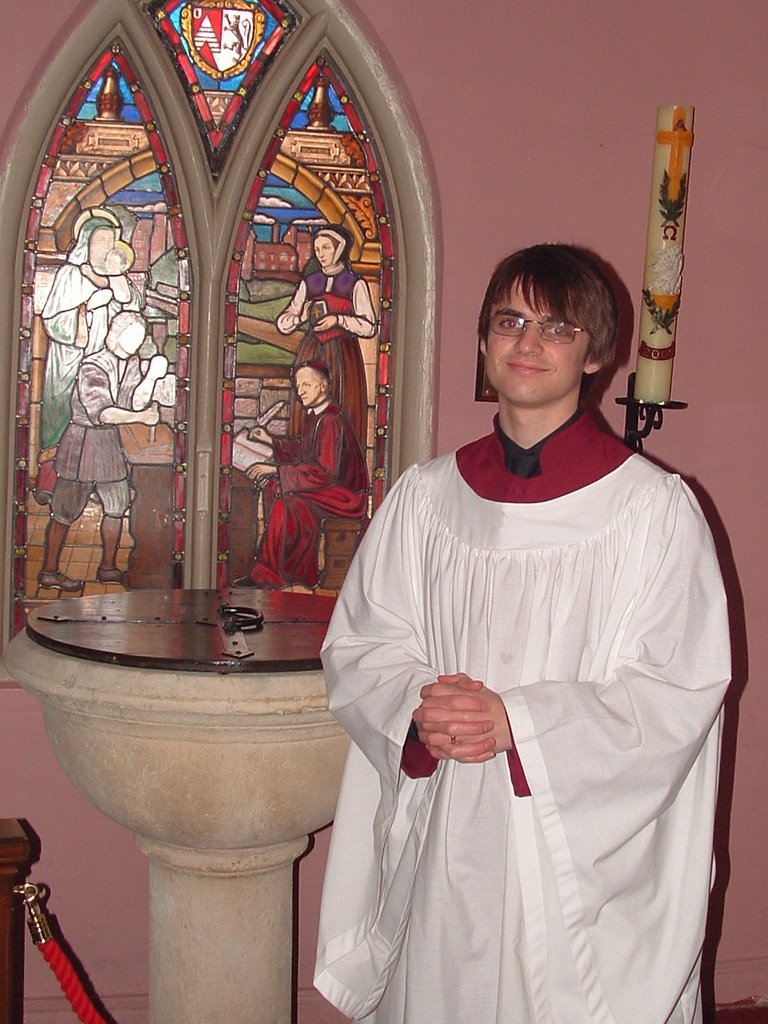
Now, those who avidly read the Mass of Ages will notice that I am the recent addition to their servers at this monthly mass, which I am very honoured to be able to now do. This time I was acolyte, and thank God, didn't mess up too much! Note in the above picture the figure of Cardinal Newman in the brand new stained glass window in the church's porch above the baptism font.

You will notice me on the right, and Fr. Higham in his fine gothic black chausable. The sanctuary is quite crampted due to the alter being removed from the wall, but the wonderful tabernacle and stained-glass windows are, I believe, features of the original church. Fr. Higham has just published a book on the history of Harvington Hall, which I hope to soon purchase.

The sermon was based around the theme of this month, the 'four last things': Death, Judgement, Heaven and Hell. Fr. Higham particularly emphased the contrast between liturgical texts from the old and new rites of mass, and that our concept of hell and judgement has diminished, particularly in the way we celebrate requiem masses.

The Neri Singers from Birmingham provided the wonderful accompaniment of Felice Anerio's Requiem, with a motet from Palestrina (De Profundis) and the communion motet was Mendelson's Beati Mortui. It was an incredibly moving mass, the first of which I have experienced. I will certainly keep my LMS card with my organ and blood donor cards in my wallet: to have my own requiem mass said according to the books of 1962!

Réquiem aetérnam dona eis, Dómine: et lux perpétua lúceat eis. In memória aetérna erit justus: ab auditióne mala non timébit.

Eternal rest grant unto them, O Lord; and let perpetual light shine upon them. The just shall be in everlasting remembrance: he shall not fear the evil hearing.

The next Tridentine Mass at St. Mary's, by Harvington Hall, will be a Sung Mass on 3rd December at 3pm for the first Sunday of Advent!