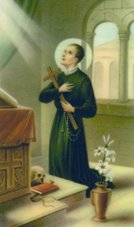
This feast was a spectacular treat. Not only was it the Solemn High Mass practised for centuries to nourish the Saints, but was concluded with Solemn Benediction of the Blessed Sacrament, and a procession around the church singing
Pange Lingua to which we are familiar from its closing verses,
Tantum Ergo, sung at regular Benediction. St Thomas Aquinas provided us with such wonderful hymns, including the sequence
Lauda Sion also sung as part of today's Mass.

The purpose of today is clear; to celebrate the wonderful gift of our salvation, present under the simple appearance of bread and wine. This is a similar mystery to that of our own life; our simple flesh and bones, and our humble works and labours, are divinised by God and transformed into beautiful channels of grace and charity. Wendy was particularly moved by reading, again and again, the translation of the words of consecration said by the Priest over the chalice:
TAKE AND DRINK YE ALL OF THIS, FOR THIS IS THE CHALICE OF MY BLOOD, OF THE NEW AND ETERNAL TESTAMENT: THE MYSTERY OF FAITH: WHICH SHALL BE SHED FOR YOU AND FOR MANY UNTO THE REMISSION OF SINS.
This 'mystery of faith', the transubstantiation, has been carefully safeguarded and expounded throughout the centuries in the vehicle Christ established: The One, Holy, Catholic and Apostolic Church. The mystery of the Mass, the partaking of Christ's Body and Blood, is one of the hardest mysteries to grasp and believe by others. In fact, when sects break away from the Church it is often this tenet of the Faith which is disregarded and cast away. During the English 'Reformation', the whole practice of the faith, particularly the Missal, was rewritten to eradicate this overarching influence. It is not surprising then, that one of the most controversial things Jesus said was concerning his identity as the Bread of Life
(St. John 6:56-67):
"For my flesh is meat indeed: and my blood is drink indeed. He that eateth my flesh, and drinketh my blood, abideth in me, and I in him. As the living Father hath sent me, and I live by the Father; so he that eateth me, the same also shall live by me. This is the bread that came down from heaven. Not as your fathers did eat manna, and are dead. He that eateth this bread, shall live for ever."
Many therefore of his disciples, hearing it, said: "This saying is hard, and who can hear it?"
But Jesus, knowing in himself, that his disciples murmured at this, said to them: "Doth this scandalize you? If then you shall see the Son of man ascend up where he was before? It is the spirit that quickeneth: the flesh profiteth nothing. The words that I have spoken to you, are spirit and life. But there are some of you that believe not."
After this many of his disciples went back; and walked no more with him.

The Church joyfully proclaims this teaching of Christ on this feast day. It is set on a Thursday to recall the day of its institution, during Our Lord's Last Supper. Free from the purple robes of mourning present on Maundy Thursday, this day the Oratory was resplendent with candles, organ music, and golden vestments. The Choir treated us with Palestrina's
Missa Papae Marcelli, which struck me as a wonderful balance between the more symphonic, operatic Mass settings of its period, and the noble simplicity of Gregorian Chant.
The Epistle is well worth a mention (
Corinthians 11:23-29), since the
Novus Ordo lectionary only has it once every 3 years (correct me if I'm wrong), and cuts it distinctly short before St. Paul's stronger admonition:
Brethren, I have received of the Lord that which also I delivered unto you, that the Lord Jesus, the same night in which he was betrayed, took bread. And giving thanks, broke, and said: Take ye, and eat: this is my body, which shall be delivered for you: this do for the commemoration of me. In like manner also the chalice, after he had supped, saying: This chalice is the new testament in my blood: this do ye, as often as you shall drink, for the commemoration of me. For as often as you shall eat this bread, and drink the chalice, you shall shew the death of the Lord, until he come. Therefore whosoever shall eat this bread, or drink the chalice of the Lord unworthily, shall be guilty of the body and of the blood of the Lord. But let a man prove himself: and so let him eat of that bread, and drink of the chalice. For he that eateth and drinketh unworthily, eateth and drinketh judgment to himself, not discerning the body of the Lord.
Quite why the last portion is left out of the new lectionary I will leave to the imagination. But surely this is an important part to note? With regards to apologetics, St. Paul would never have spoken this strongly about a merely symbolic act. He is implying sacrilege, which is a worthy consideration in offering fitting worship to the True God, present Body and Blood, Soul and Divinity. In the wider context of what St. Paul was writing to the Corinthian church; their degradation of the Lord's Supper into a common feast put them in a dangerous position before God, resulting in curses such as weakness, infirmity and even death.

Fr Paul Chavasse, celebrant, touched thoughtfully on this during his sermon. We should be grateful that we live in an age of the Church where we have the privilege of regular and frequent reception of Holy Communion (I think Pope St Pius X did a lot to encourage this during his pontificate at the beginning of last century). But that should not mean that we do so carelessly: we should have frequent recourse also to the sacrament of confession, where we reconcile ourselves to Christ through forgiveness of our sins and receive the special graces we need to reform our lives.

Fr Paul also spoke eloquently about this feast's position in the calender just after Pentecost, when we think carefully about the way the Holy Spirit works not just in our immediate lives but over the course of many centuries in the Church's life. I would say that we cannot expect the Holy Spirit to create a sudden reform of the Church as seen by the pentecostals: such sudden, thoughtless impulses may bring about far worse and open up disastrous consequences. We must trust in prayer, integrity and self sacrifice. Only by living our lives through a child-like faith in the Church can we hope to be led by the Spirit to reform ourselves and others. Such is the example of the Saints and Apostles. When Our Lord asked them "
Will you also go away?" Simon-Peter answered "
Lord, to whom shall we go? thou hast the words of eternal life. And we have believed and have known, that thou art the Christ, the Son of God." Let us be one with St. Peter, the Rock on which we build our Faith, and humbly trust that even in those things we do not understand, we can be led to all Truth.


 Further to my post on Edward Elgar (memorial stained glass window, left, based on his composition of Newman's Dream of Gerontius) I thought I would elaborate on this great Anglican Cathedral in Worcester. There was first a Cathedral here, on the banks of the river Severn, as early as 680 when Bosel was consecrated as first Archbishop. Since then the great St Oswald (925-992) built a second larger Abbey Church with a Monastery. Another noteworthy Saint was Wulfstan (1009-1095) who was prior of the Monastery before becoming Bishop in 1062. The crypt is all that remains of St Wulfstan's Cathedral, which was started in 1082. The current building dates from the 12th and 13th Centuries.
 It is striking on entering this building; the vastness of the roof vault, the great gothic arches, the sheer distance from one end to the other. Indeed, there is a darkness and mystery to the Cathedral, which must have seemed quite overwhelming as Mass was being said at the distant High Altar (right). It is important to remember that High Masses would have been enriched with music, several ministers, choir members in copes, incense etc etc which all serve to engage the senses. The distance from laity to clergy would have not been a major issue, especially as Low Masses would have been at people's altars where views were unobstructed. One can see where Pugin would have got his great gothic inspiration; the Rood Screen is beautiful!

 The long history of the Cathedral once attracted a great many pilgrims, to the shrines of Ss Oswald and Wulfstan, throughout the middle ages. Our own pilgrimage led us to Wulfstan's crypt (left), there being nowhere else to pay our veneration. By the time of the English 'Reformation' the Cathedral was actually a Benedictine Priory, and it was only the monastery which was torn down by Henry VIII (the ruins are still visible by the river). The Abbey Church was preserved and converted into a Cathedral for Secular Clergy, although the Tomb Shrines of Oswald and Wulfstan were destroyed. Between them still lies the tomb and effigy of King John (1167-1216), who is surely most famous from the fables of Robin Hood!? (Which reminds me - I really should write a rant about the ridiculous Islamic portrayal of my Nottingham hero in recent years, resulting in the great Catholic Friar Tuck being eradicated from the story in the latest BBC dramatisation!!!) It is likely that this royal connection, along with Prince Arthur's Chantry (who was Henry VIII's older brother, and first husband of Catherine of Aragon) were the features which preserved the Cathedral from destruction.